
RICHMOND – A new report from the Virginia State Police (VSP) reveals a massive expansion in automated speed enforcement across the Commonwealth, with civil penalties collected from photo speed monitoring devices topping $54 million in 2025.
The “2026 Report on Photo Speed Monitoring Device Usage,” submitted to the General Assembly by VSP Superintendent Colonel Jeffrey S. Katz, details a year of record-breaking growth for the controversial safety technology. According to the data, which spans January 1 through December 31, 2025, the number of law enforcement agencies participating in the program jumped to 49, a significant increase from just 13 agencies three years prior.
Sky-High Violations and Revenue
The report highlights a staggering 957,780 violations prosecuted during the 2025 calendar year. Of those, 607,899 resulted in successful prosecutions, which include both court convictions and penalties paid in lieu of an appearance.
While the law caps individual fines at $100, the sheer volume of infractions has created a significant financial stream.
- School Crossing Zones: Remained the primary source of activity, generating $34.4 million from over 656,000 violations.
- Highway Work Zones: Though fewer in number, these zones were highly active, netting $19.6 million in penalties.
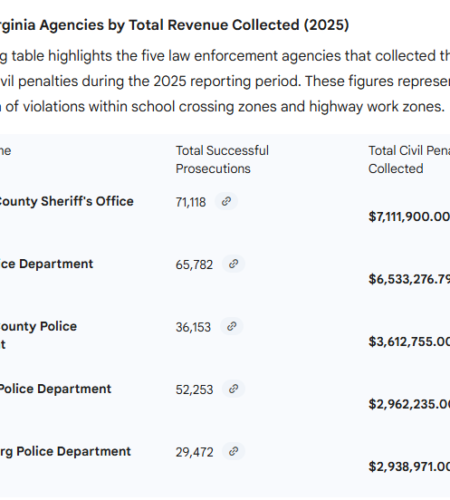
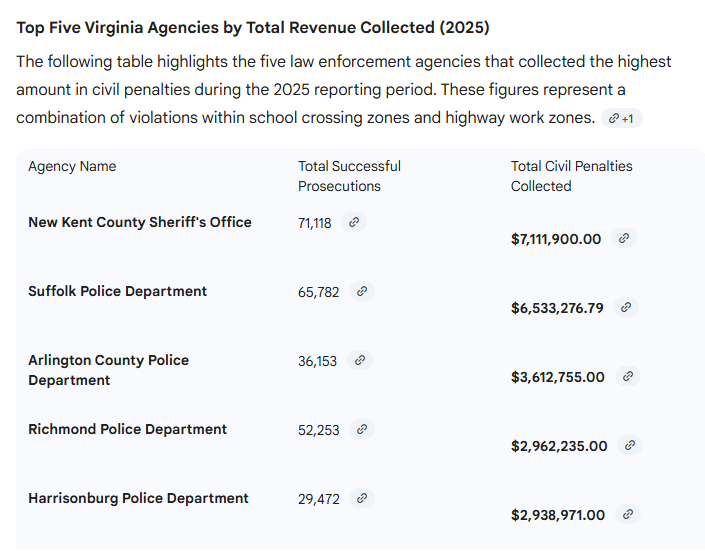
New Kent County emerged as a major hub for enforcement, collecting more than $7.1 million in penalties—the highest of any single agency in the report—largely driven by monitoring on Interstate 64. Other high-revenue localities included Suffolk ($6.5 million) and Arlington County ($3.6 million).
Safety vs. Surveillance
Authorized under Virginia Code § 46.2-882.1, these devices use radar or LIDAR to capture images of vehicles exceeding posted limits by at least 10 mph. Proponents argue the systems are essential for protecting “sensitive areas” like school crossings and work zones. The data shows some evidence of a “calming effect” on traffic; in several zones, such as at Francis C. Hammond Middle School in Alexandria, average speeds dropped from 26 mph during the warning period to 22 mph once active enforcement began.
However, the program remains a point of contention for some motorists. Unlike traditional speeding tickets, these are civil penalties that do not add demerit points to a driving record or impact insurance premiums. Critics often point to this distinction as evidence that the programs are designed more for revenue than for rigorous law enforcement.
Where the Money Goes
The destination of the $54,096,163 collected depends on who issued the ticket:
- Localities retain fines issued by local police.
- State Police fines are diverted to the Literary Fund, which supports public education.
- High-Risk Intersection penalties (though none were reported in 2025) are earmarked for the Virginia Highway Safety Improvement Program.
As the 2026 legislative session continues, lawmakers will likely weigh this massive revenue growth against ongoing public concerns regarding privacy and the transparency of how these automated zones are selected.
The entire 154-page report may be found here.
Comments