The Shenandoah Valley Black Heritage Project raises money in Virginia, but its legal authority to do so expired more than a year ago — and most of the grants it paid out had nothing to do with its stated mission.
A Harrisonburg nonprofit that bills itself as the custodian of the Shenandoah Valley’s African American heritage has been soliciting donations from Virginia residents without a valid charitable registration for more than sixteen months, according to records obtained from the Virginia Department of Agriculture and Consumer Services. A review of the organization’s tax filings reveals a second problem: the overwhelming majority of its grant spending over the past two years went to performing arts institutions in New York, New Jersey, and Massachusetts that have no apparent connection to African American history in the Shenandoah Valley.
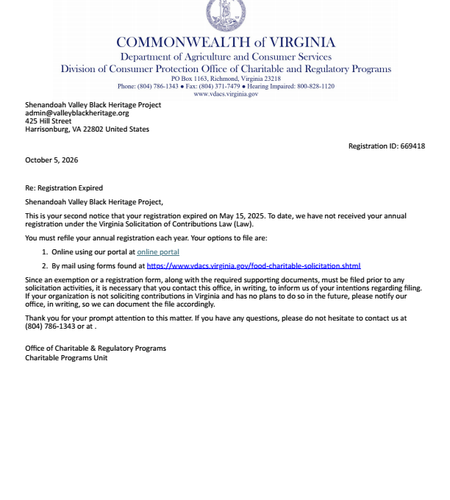
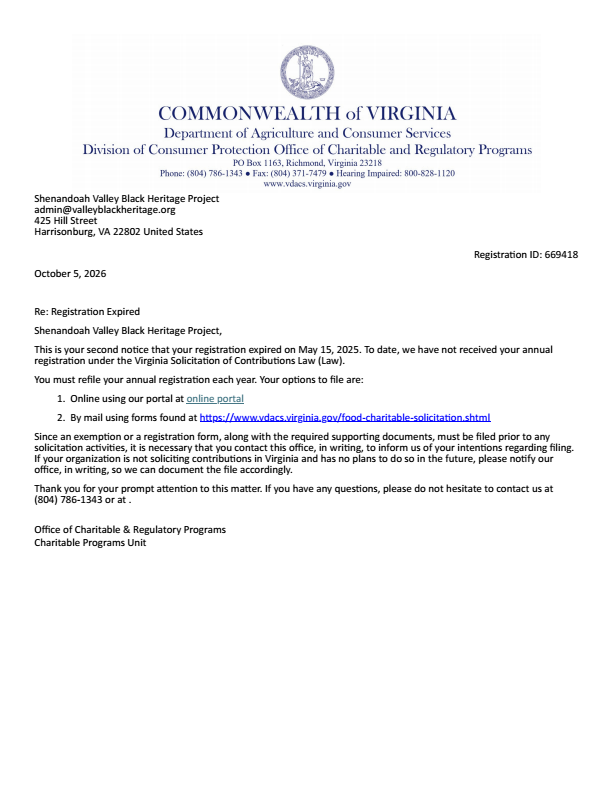
The Shenandoah Valley Black Heritage Project, Inc. (SVBHP), which operates a Heritage Center at 425 Hill Street in Harrisonburg and asks the public for money on its website and through direct mail, special events, and personal contact, allowed its Virginia Solicitation of Contributions registration to lapse on May 15, 2025. As of October 5, 2026, the organization had still not renewed. That date is significant because it is the date VDACS sent SVBHP a second notice of expiration, Registration ID 669418, addressed to admin@valleyblackheritage.org, warning that the organization must refile before conducting any solicitation activities in the Commonwealth.
Under Virginia’s Solicitation of Contributions Law, Code of Virginia Section 57-49 et seq., a charitable organization must file an annual registration statement with VDACS before soliciting contributions in Virginia. The law applies to all solicitations, including website donation pages, direct mail, and personal contact. Operating without a registration is not a technicality. The statute makes an active registration a condition precedent to any solicitation activity.
SVBHP signed its most recent Form 102 registration statement on June 27, 2024, when Robin Lyttle (Acting Treasurer and Grants Administrator) and Monica Robinson (Director) both affixed wet-ink signatures under oath. That document, obtained from VDACS, covered fiscal year 2023 and extended the organization’s registration through May 15, 2025. The organization has not renewed it since.
The lapse matters because SVBHP’s website continues to solicit donations, and its own 2024 Form 990, filed with the IRS in November 2025, reports $223,260 in contributions received during calendar year 2024, the entire period after the registration expired.
A New York Foundation Drives the Finances
Whatever the public may assume about a local heritage organization raising money from local supporters, the actual donor picture is different.
The Schedule B (Schedule of Contributors) attached to SVBHP’s 2023 Form 990, a document that is typically withheld from public disclosure but which was included in SVBHP’s VDACS submission and is therefore a public record, identifies the organization’s large donors by name.
The dominant contributor in 2023 was the Jerome L. Greene Foundation, located at 146 Central Park West, Suite 1E, New York, NY 10023, which gave $75,000. The only other named contributor was Donald Huck of 91 1/2 Franklin Street, Harrisonburg, who gave $5,700. Total contributions reported for 2023 were $155,518, meaning the New York foundation alone accounted for nearly half the organization’s annual revenue.
The 2022 Schedule B, also in the VDACS file, shows the same pattern. The Jerome L. Greene Foundation again led with $76,000. The second-largest contributor that year was Robin Lyttle herself, the organization’s founder and then-Vice President, who donated $6,250 from a P.O. Box 301, Basye, VA 22810 address while simultaneously serving as VP, acting treasurer, and the person with signatory power over the organization’s funds. Donald Huck contributed $5,700.
The Greene Foundation’s consistent six-figure support raises a question the organization’s public communications do not address: to what extent is SVBHP a locally supported community institution versus a vehicle for channeling out-of-state foundation money into the Shenandoah Valley? The answer has implications for how donors and the public evaluate the organization’s accountability to local stakeholders.
Where the Money Goes — and Why It Doesn’t Match the Mission
SVBHP’s stated mission, as printed on its Form 990 and its VDACS registration, is to recover and illuminate the rich African American history of the Shenandoah Valley. A review of its Schedule I filings — which document grants and assistance paid to other organizations — shows that mission and spending diverged sharply in 2022 and 2023.
Across those two years, SVBHP distributed $129,788 in grants. Of that total, $9,035 — roughly seven percent — went to an organization with a direct, documented connection to the Valley’s African American heritage. The remaining 93 percent funded performing arts institutions located in New York, New Jersey, Massachusetts, and California.
Here is what each recipient organization actually does:
In 2022, SVBHP paid $5,000 to IndieSpace of Astoria, New York, which celebrates and centers independent theater-making in New York City, providing funding, real estate programs, professional development, and advocacy to individual artists, theater companies, and indie venues. It has no African American history component and no Virginia connection.
It paid $10,000 to the New Jersey Performing Arts Center in Newark, which describes its mission as being America’s foremost urban presenter of arts and entertainment and a leader in arts education for children in Newark. It is a major urban performing arts venue. It has no African American history focus and no Virginia connection.
It paid $13,000 to The Joyce Theater in New York City, described on the Schedule I as being for the purpose of supporting the Malpaso dance company. Malpaso Dance Company is a young Cuban contemporary dance ensemble and associate company of Joyce Theater Productions, founded in Havana in 2012. Its work blends contemporary modern dance with Afro-Cuban traditions. It has no connection to Shenandoah Valley African American history.
It paid $5,000 to Windhover Performing Arts in Rockport, Massachusetts, whose mission is to offer classes, workshops, and performances in dance and related arts to the Northshore community of Cape Ann. It is a small outdoor dance venue on the Massachusetts coast with no African American history component and no Virginia connection.
It paid $5,000 to Give2Asia of Oakland, California, whose mission is to strengthen communities throughout Asia by building trusted networks for charitable investment. Give2Asia is an international philanthropy intermediary that channels charitable grants to organizations in 23 countries across the Asia-Pacific region. It has no connection to African American history or Virginia under any interpretation.
It paid $8,000 to Groundswell of Washington, DC — technically the New York City-based Groundswell Community Mural Project — which engages youth in creative processes at the intersection of arts education, youth development, and social justice through community murals in New York City’s five boroughs. It has a social justice orientation and works with diverse communities, but has no specific African American history focus and no Shenandoah Valley presence.
It paid $9,035 to Fairview Cemetery in Staunton, the smallest grant on the list, for summer maintenance. This is the one grant that directly aligns with SVBHP’s mission. Fairview was founded in 1868-69 by two Staunton-based African American churches, stands among the largest historically African American cemeteries in the Commonwealth outside of Richmond, and was added to both the Virginia Landmarks Register and the National Register of Historic Places in 2025. It is a genuine Valley African American heritage site. SVBHP’s own website lists it as a site of significance.
In 2023, SVBHP made only three grants. It paid The Joyce Theater $20,000 — a $7,000 increase from 2022 — again for support of the Malpaso Cuban dance company. It paid $10,000 to the Schoolhouse Theater Foundation of Croton Falls, New York, a small regional professional theater in Westchester County whose mission is to promote, cultivate, develop, aid, and advance the public interest in, and appreciation and understanding of the theatrical arts. The Schoolhouse has no African American history component and no Virginia connection. And it paid $27,500 to Brooklyn Arts Exchange, a multigenerational arts organization in Park Slope, Brooklyn, nurturing creative expression and artistic process through education, residencies, and performance at the intersection of arts and social justice. Brooklyn Arts Exchange serves artists from historically underrepresented backgrounds, but it is a Brooklyn dance and theater incubator with no Shenandoah Valley connection and no African American history preservation focus. This was the single largest grant SVBHP made in either year.
No grants at all went to Virginia-based organizations in 2023.
The pattern is consistent: the organization collects money in Virginia, primarily from a New York foundation, and distributes most of it to New York performing arts institutions. The one grant that unambiguously fits the mission — the Fairview Cemetery maintenance payment — was also the smallest, and it was made only in 2022.
A Depleted Board
Governance questions arise from the official board roster SVBHP submitted to VDACS as part of its 2024 Form 102 filing, a document obtained from that agency reflecting the state of the board as of December 31, 2023.
That document, on SVBHP letterhead, lists the following positions and their occupants:
President: Vacant Vice President: Vacant Treasurer: Vacant Acting Treasurer and Grants Administrator: Robin Lyttle Corresponding Secretary: Barb Melby Recording Secretary: Vacant Members-at-large: Kevin Borg.
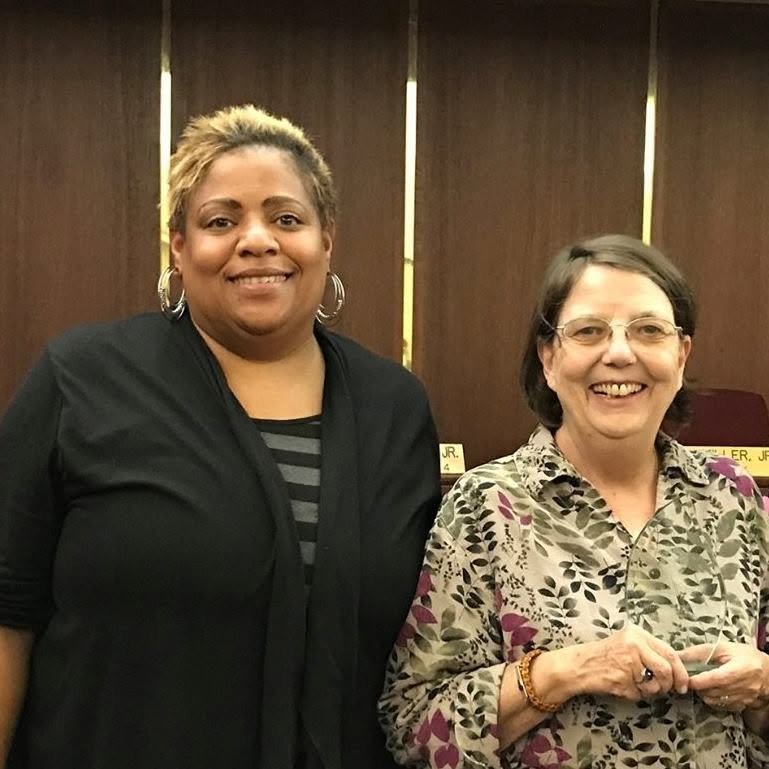
Under “Contractors,” the document lists Monica Robinson as Director and Taya Whitley as Researcher.
At the end of 2023, three of the organization’s four officer positions were vacant, and Lyttle, who had stepped back from a formal officer title upon her announced retirement, was still carrying the organization’s fiscal functions as acting treasurer and grants administrator. The paid executive director and the paid researcher were listed not as staff but as contractors, raising questions about how compensation was structured and reported.
The 2023 Form 990, signed by Lyttle as Vice President on June 20, 2024, reports one voting member of the governing body and one independent voting member. An organization raising more than $150,000 annually with a single-person governing structure and three vacant officer seats operates with minimal governance redundancy.
The same 990 confirms that SVBHP had no written conflict of interest policy, no written whistleblower policy, and no written document retention and destruction policy. It also confirms that financial statements were neither compiled, reviewed, nor audited by an independent accountant.
Compensation Growth Without Proportional Growth in Local Programming
Between 2021 and 2024, executive compensation paid to Monica Robinson grew from $12,466 to $49,494, a nearly fourfold increase. The 2024 990 reports she averaged 20 hours per week in that role, placing her effective rate at roughly $47 per hour for a 52-week year.
Over the same period, the organization’s stated program accomplishments remained modest in scope: self-guided driving tours, an annual Soul Food event at the Lucy F. Simms Center, genealogy assistance, and DNA kit distributions. The 2023 990 reports 12 volunteers and zero employees on payroll.
The compensation trajectory is not inherently improper, and executive directors of growing nonprofits legitimately earn more as organizations scale. But when set against the governance deficits described above and a grant record that sent 93 cents of every grant dollar out of state, the absence of an independent compensation review process is notable. The 990 confirms that no independent review or comparability analysis was used to set the executive director’s pay.
What VDACS Told the Organization
Correspondence obtained from VDACS tells a straightforward story. A July 24, 2024 letter from registrations analyst Aaron Graves noted that SVBHP had submitted a duplicate registration for fiscal year ending 12/22 and requested the signed 2023 financial report and corrected pages from the Form 102. SVBHP complied, and VDACS issued a registration confirmation dated August 1, 2024, valid through May 15, 2025.
SVBHP did not renew by that deadline. The October 5, 2026 second-notice letter, also obtained from VDACS, from the Office of Charitable and Regulatory Programs states plainly: “This is your second notice that your registration expired on May 15, 2025. To date, we have not received your annual registration under the Virginia Solicitation of Contributions Law.” The letter warns that “a registration form, along with the required supporting documents, must be filed prior to any solicitation activities.”
By the time that letter was sent, SVBHP had already received, and spent, a full year’s worth of donations raised during the lapse period.
A Comment Request Was Sent
The Republitarian submitted a written request for comment to SVBHP at admin@valleyblackheritage.org and director@valleyblackheritage.org asking the organization to respond to the following questions: Why has the Virginia charitable registration not been renewed since May 2025? What is the current status of the board’s officer positions? What is the relationship between the Jerome L. Greene Foundation’s grant funding and SVBHP’s mission in the Shenandoah Valley? And what criteria does the organization use to select out-of-state performing arts organizations as grant recipients?
I’ll publish any response from Executive Director, Monica Robinson, upon receipt.
What the Law Requires
Virginia Code Section 57-49 requires every charitable organization soliciting contributions in Virginia to register annually with VDACS. Section 57-61.1 makes registrations effective “if complete, upon receipt” by the Commissioner, meaning a lapsed registration cannot be retroactively cured. Section 57-49.D requires organizations to advise potential donors in written solicitation materials that a financial statement is available upon written request from the OCRP.
Donors who gave to SVBHP after May 15, 2025, gave to an organization operating outside its required legal framework. Those who gave in 2022 or 2023 — when the registration was valid — may reasonably ask whether their contributions went toward recovering the African American history of the Shenandoah Valley, or toward performing arts organizations in New York, New Jersey, Massachusetts, and California that have little or nothing to do with that mission. The answer, drawn from the organization’s own tax filings, is mostly the latter.
Comments