
James Madison University’s beloved Duke Dog has apparently been drafted into partisan politics, and nobody seems to have asked JMU first.
A get-out-the-vote flyer posted online this week by the Harrisonburg Democratic Party targets JMU students with the headline “Your Future Is On The Ballot!” Perched in the corner, wearing his trademark crown and rendered in JMU purple and gold, is a cartoon of the university’s bulldog mascot. Below him, the flyer tells students where to vote early in Harrisonburg and Rockingham County, then urges them to “Vote Our Democratic Ticket”: Mark Warner for Senate, Beth Macy for Congress, and Dany Fleming and Monica Robinson for Harrisonburg City Council. It also asks for a yes vote on all three proposed constitutional amendments.
What the flyer does not include is just as notable. Nowhere does it say who paid for it. A second graphic the party posted for the same students goes further, using JMU’s own registered logo. And the JMU Foundation, which controls the mascot, says a cease-and-desist letter is on the way.
The Dog Belongs to JMU
The Duke Dog is not public property. JMU has assigned all rights in its trademarks, logos, insignia and mascot to the James Madison University Foundation, which runs a licensing program through the Collegiate Licensing Company. Even JMU’s own student clubs and Greek organizations must get approval before putting university marks on a project.
The university is also clear about politics. JMU Policy 1509 prohibits using university images for any commercial, nonprofit or political enterprise or cause without JMU’s written consent. A public university funded by Virginia taxpayers has every reason to keep its mascot out of a partisan slate card, and its students of every political stripe have every reason to expect it to.
There is no indication that JMU approved this use, and its licensing arm is not taking it lightly. When contacted by The Republitarian, the JMU Foundation said it will be issuing a cease-and-desist letter immediately.
A Second Graphic, and the Real Logo
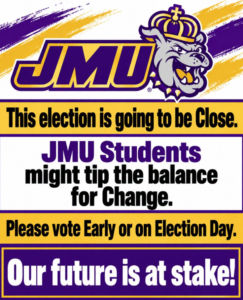
A second image, also posted by the Harrisonburg Democratic Party, is even bolder. It is built around JMU’s block “JMU” wordmark, complete with the ® registration symbol, beside the crowned Duke Dog on a purple-and-gold background. To a casual viewer, it reads like an official message from the university.
The text tells students the election “is going to be Close” and that “JMU Students might tip the balance for Change,” then urges them to vote early or on Election Day because “Our future is at stake!” It names no candidate or party. Like the first flyer, it carries no sponsor identification of any kind.
The word “Change” does a lot of work in a graphic that otherwise pretends to be neutral. Coming from a partisan organization, the effect is to dress up a political pitch as university communication, using a mark JMU has registered and licenses carefully.
Could JMU Sue?
In fairness, a trademark lawsuit would be an uphill climb. The strongest theory is false endorsement under Section 43(a) of the federal Lanham Act, since a crowned purple-and-gold bulldog next to the words “JMU Students” plainly suggests the university is on board. But the Fourth Circuit, whose rulings govern Virginia, held in Radiance Foundation v. NAACP (2015) that noncommercial advocacy using another organization’s name falls outside the Lanham Act’s reach. A dilution claim fares no better, because federal law expressly exempts noncommercial use.
The cartoon in the first flyer also appears to be a new drawing, not a copy of JMU’s official artwork, which weakens any copyright claim. The second graphic is a different matter. Reproducing the registered JMU wordmark, ® and all, comes much closer to a counterfeit of the university’s own branding and makes any suggestion of official endorsement harder to deny.
That may be why the Foundation is starting with a cease-and-desist letter rather than a lawsuit. Letters like that usually end with a quiet takedown. That the law may let someone get away with it, though, does not make it right. Borrowing a university’s identity to imply its students’ mascot backs one party’s candidates is exactly the kind of thing JMU’s policy exists to prevent.
Who Paid for It?
The bigger legal question is the missing sponsor line. Under Va. Code § 24.2-956.1, it is unlawful for a political committee to sponsor a print media advertisement that counts as a reportable expenditure unless it bears the statement “Paid for by” followed by the committee’s name. When such an ad appears electronically, the disclosure must be at least seven-point type or reachable by clicking through to a page that displays it.
The flyer carries no such statement anywhere.
Whether that is a violation depends on how it was produced and spread. Virginia’s disclosure chapter covers print media, broadcast, and online ads placed or promoted for a fee. If the flyer was printed and posted around campus, handed out, or boosted on Facebook for money, the missing disclaimer is a problem. If it was only shared for free on a committee’s own page, state law likely does not reach it. The second graphic, which names no candidate, probably falls outside the disclosure rule altogether, but it is no less anonymous.
Because the flyer promotes two federal candidates, Warner and Macy, federal rules may also come into play. Political committees that pay for public communications generally must include a disclaimer under Federal Election Commission regulations, though local party volunteer materials have exemptions that could apply.
Rules for Thee
Disclosure laws exist so voters know who is trying to persuade them. They apply to every party and every committee, and local Republicans would rightly be called out if they put an unattributed slate card in front of students with a university mascot on it.
The voters this flyer targets deserve straight answers. Who designed it? Who paid to print or promote it? Did anyone ask JMU before putting the Duke Dog on a partisan ballot pitch? And will the sponsor add the disclosure Virginia law requires?
The Harrisonburg Democratic Party put these graphics in front of students. If it paid to print or promote either one, it should say so on the graphic itself. That is the law, and it is the least JMU students should expect from people asking for their votes.